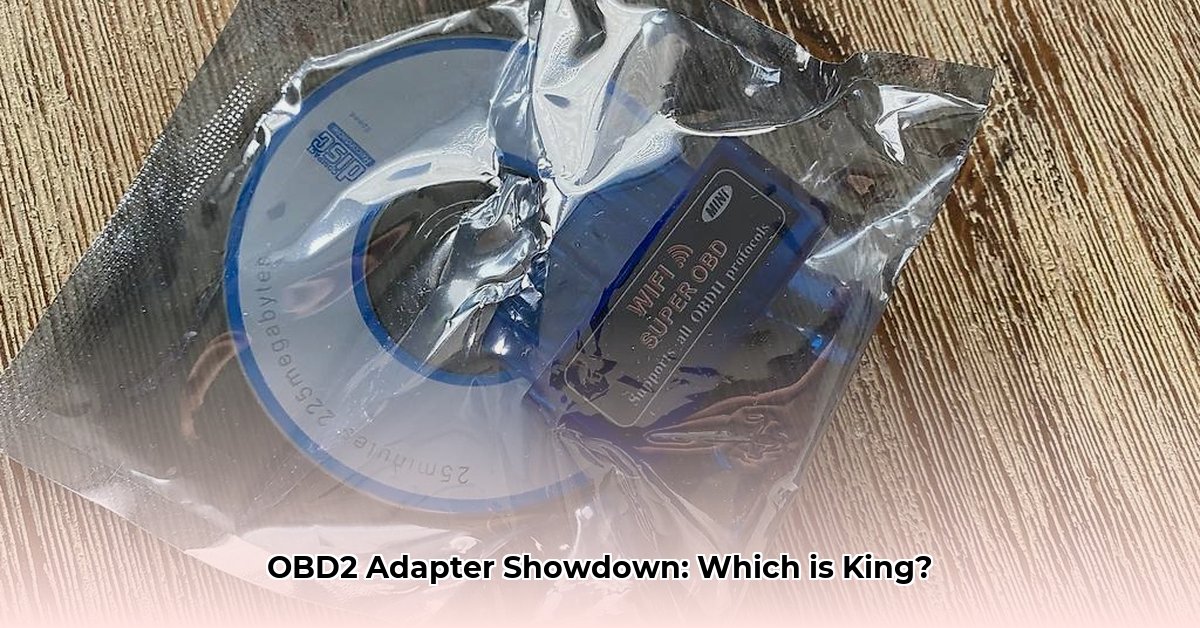
Choosing the right OBD2 Wi-Fi adapter can significantly enhance your ability to monitor and maintain your vehicle. This review compares two popular options: the OBDLink MX and the ELM327, analyzing their performance, features, and security to help you make an informed decision. We'll cover speed, protocol support, security, cost, software compatibility, and more, providing a clear comparison to guide your purchase.
Speed and Performance: Real-Time Data vs. Delayed Updates
The OBDLink MX boasts significantly faster data transfer speeds than the ELM327. This translates to near real-time updates on your vehicle's diagnostic information, allowing for immediate analysis of critical data points. The ELM327, while functional, exhibits noticeable delays in data transmission. This speed difference is a crucial factor for users requiring immediate feedback, such as monitoring live engine parameters during performance testing. Does near-instantaneous data acquisition justify the higher price? That's a decision only you can make.
Protocol Support: Broad Compatibility vs. Standard Compliance
Both adapters support standard OBD-II protocols, the basic communication language for vehicle diagnostics. However, the OBDLink MX extends its capabilities by supporting various manufacturer-specific protocols, providing access to more detailed and vehicle-specific data. The ELM327 primarily adheres to standard OBD-II, potentially limiting its access to certain proprietary vehicle information. A wider protocol support allows for more comprehensive diagnostics and potentially greater compatibility across different vehicle makes and models.
Security: Protecting Your Vehicle's Data
Security is paramount when connecting any device to your vehicle's onboard computer system. The OBDLink MX incorporates robust security features designed to protect against unauthorized access and data breaches. While the ELM327 functions adequately for many, detailed security specifications are less readily available, raising potential concerns for security-conscious users. The enhanced security measures offered by the OBDLink MX may be crucial for individuals prioritizing the protection of their vehicle's sensitive data against potential hacking attempts.
Cost: Balancing Budget with Functionality
The OBDLink MX commands a higher price compared to the ELM327. The ELM327's significantly lower cost makes it an attractive budget-friendly option. However, this price difference reflects the disparities in features, performance, and security. The OBDLink MX's premium price reflects its advanced capabilities and enhanced security. For the budget-minded consumer, the ELM327 offers basic functionality at a lower cost, but is it worth compromising on performance and security?
Software Compatibility: Seamless Integration vs. Third-Party Reliance
Both adapters work with a wide array of third-party OBD-II diagnostic apps. However, the OBDLink MX offers a competitive advantage by including its own dedicated suite of mobile applications, providing a more integrated and potentially seamless user experience. While the ELM327 relies primarily on third-party apps, introducing potential compatibility issues and a more fragmented user experience, the inclusive software bundle with the OBDLink MX offers added value.
Feature Comparison: A Side-by-Side Analysis
| Feature | OBDLink MX | ELM327 |
|---|---|---|
| Speed | Significantly Faster | Noticeably Slower |
| Protocol Support | Broader, including proprietary protocols | Standard OBD-II protocols |
| Security | Strong security features | Security details less publicized |
| Cost | More expensive | Less expensive |
| Software | Includes dedicated apps plus third-party support | Primarily third-party app support |
Choosing Your OBD2 Wifi Adapter: A Practical Guide
The optimal choice hinges on your budget and specific diagnostic needs. If speed, enhanced security, comprehensive software support, and access to manufacturer-specific protocols are paramount, the OBDLink MX justifies its higher price tag. Conversely, if budget constraints are a major concern and basic OBD-II functionality suffices, the ELM327 provides a viable, affordable solution. Carefully weigh your priorities to arrive at the best decision for your automotive needs.
Key Takeaways: Three Pivotal Points
- Speed and Performance: The OBDLink MX offers significantly faster data transfer speeds than the ELM327.
- Security and Features: The OBDLink MX provides enhanced security features and more advanced diagnostic capabilities.
- Cost Consideration: The ELM327 is a more budget-friendly option, while the OBDLink MX offers greater performance and security.
Note: Information provided is based on publicly available data and user reviews. Individual experiences may vary.
⭐⭐⭐⭐☆ (4.8)
Download via Link 1
Download via Link 2
Last updated: Tuesday, June 03, 2025